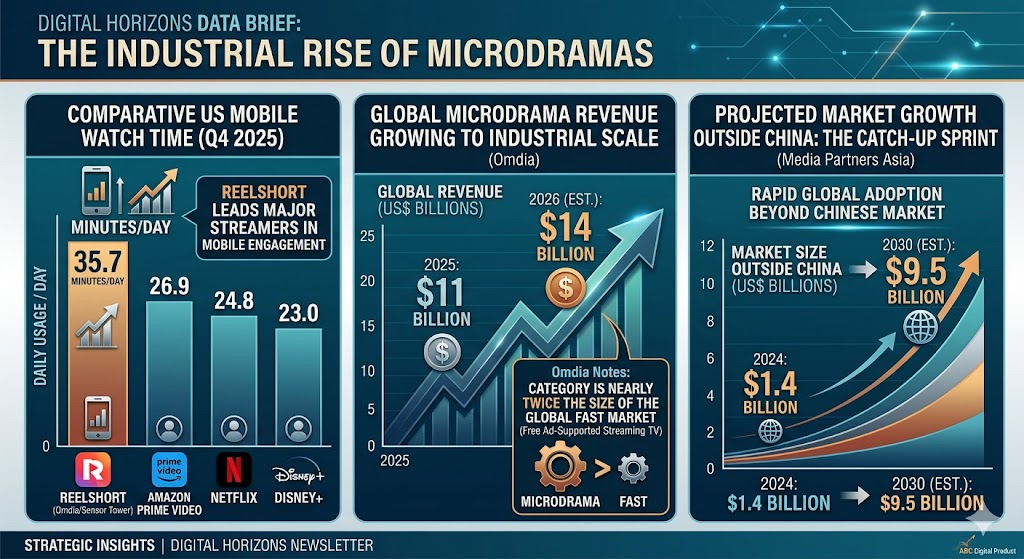
This is already a serious mobile entertainment business, and it’s no longer just a China story. My own path into being hooked was via Facebook, and that is a key point: discovery is happening heavily through all the social platform feeds, not just the dedicated apps.
And like many shifts that look ridiculous at first glance, this one becomes much more serious once you stop looking only at the current aesthetics and start looking at the engine underneath. Chinese digital formats have a habit of looking local, strange, or easily dismissible right up until they begin travelling.
What media leaders are misreading
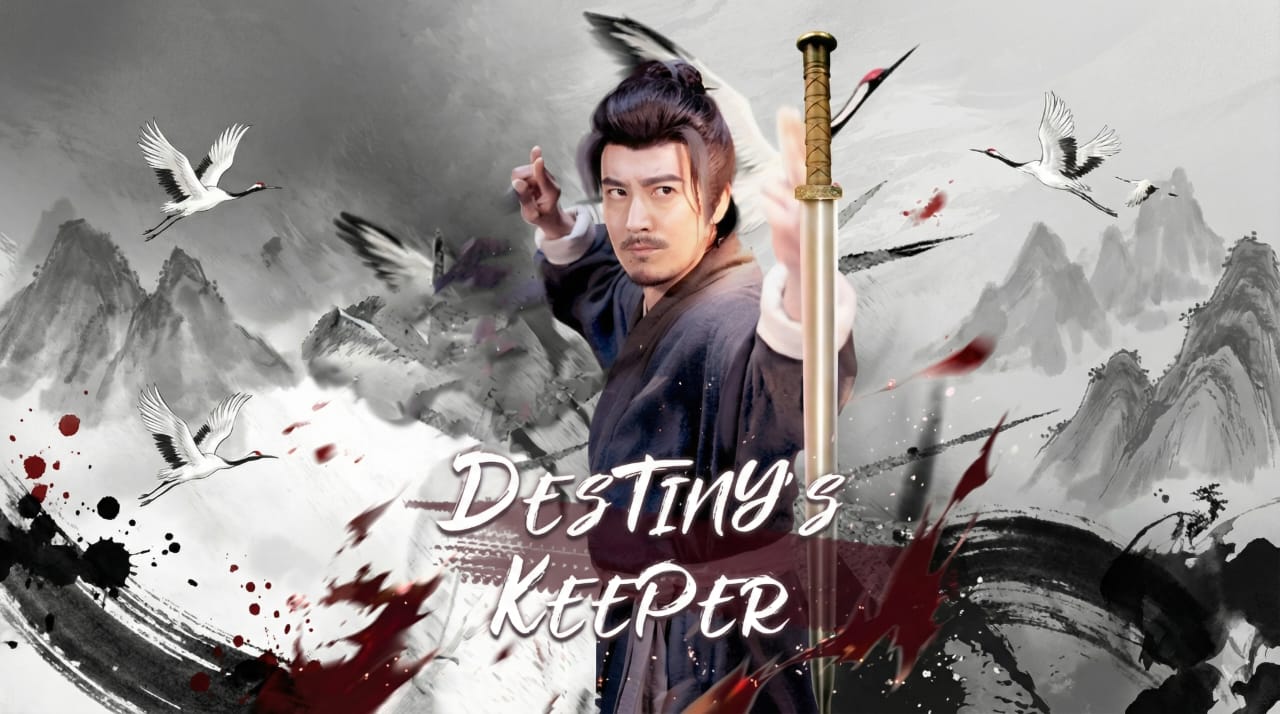
It’s tempting to write off microdramas as cheap vertical soaps: billionaire fantasies, forbidden alphas, revenge melodramas, secret-heiress plots, cliffhangers every 90 seconds. There are truckloads of fast, disposable titles being churned out weekly on the cheap that support that judgement.
A small sample: The Double Life of My Billionaire Husband; Fated to My Forbidden Alpha; Never Divorce a Secret Billionaire Heiress, Revenge of the XXL Wife – and, because the genre has no shame, Found a Homeless Billionaire Husband for Christmas.
But that misses the point. These platforms are getting very good at producing, testing, localising, distributing, and monetising emotionally sticky stories built for the phone.
In China, that is more likely to mean mythology, wuxia, or status-reversal fantasies — the humiliated outsider rising to power. In Western markets, romance, scandal, revenge, and melodrama do more of the work. The genres vary by market. The emotional machinery is strikingly similar.
The day the factory came into focus
I already knew what it felt like to be on the receiving end — phone in hand, coffees going cold, hunting the next episode. In Beijing last year, across both the Asia-Pacific Broadcasting Union’s AI and Media forum and the wider vibrant broadcast-tech scene, I saw the production side.
When I first started talking about this after Beijing, I treated microdramas mainly as a Chinese AI experimentation zone. I suspected they might become more than that, but I didn’t yet have enough evidence to say so with confidence.
Sitting in a room full of Asia-Pacific broadcasting executives, I watched Professor Shen Yang of Tsinghua University demonstrate how a single sentence could generate a complete broadcast video: research, script, avatar, visuals, and voice. One command. A complete broadcast video.
I wrote three words in my notes: one sentence generation.
I was there to give a masterclass on responsible AI adoption — human oversight, augmentation rather than replacement, people taking on a new role of AI directors. What I was seeing was something else: not just a better tool, but the blueprint of an automated content factory.
That moment stuck with me because the ambition was impossible to miss.
In much of the world’s media, AI is still approached mainly as a productivity layer: better search, better transcription, better summarisation — assistance around the margins of existing workflows. Useful, sensible, and responsible.
In China’s microdrama sector, storytelling is being treated as software.
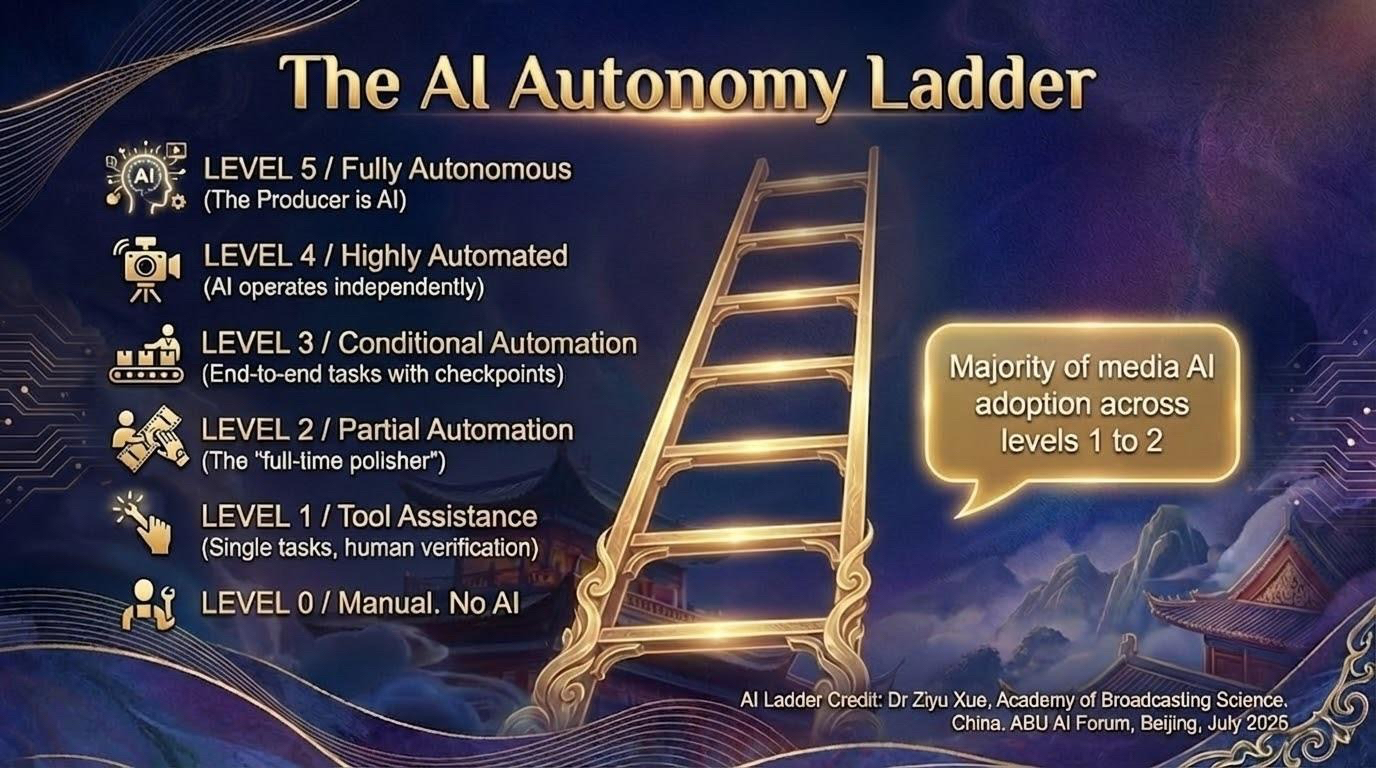
Think of AI adoption as a ladder. At the lower levels, AI handles individual tasks — transcription, summarisation, archive search. Higher up, it begins to chain tasks together and execute larger parts of a workflow under human direction.
Most Western media organisations are still on the lower rungs. What stood out in China’s broadcast media sector was the ambition to push toward the top — where AI doesn’t just execute the chain, but begins to drive it. The producer is the algorithm.
Inside the Vertical Story Factory
Chinese companies later began exporting the model globally through apps such as ReelShort, DramaBox, and ShortTV. What is taking shape now is not just a format, but a full production system.
Hengdian World Studios in Dongyang, long established as China’s largest film and television production base, hosted more than 3000 microdrama crews last year, a 286% increase year-on-year. Its traditional horizontal film stages are increasingly supplemented by “Shudian” — vertical studios purpose-built for the format.
Around 160 kilometres southwest, Quzhou’s Meigao Short-Drama Super Factory takes the industrial logic further: 200 purpose-built sets across 66,000 square metres, running 30 productions simultaneously.
And 150 kilometres northeast of Hengdian, the Versatile AI Virtual Film Base in Deqing operates five LED virtual studios including the world’s largest curved LED volume stage. Microdrama crews can film “around the world” in a single room. There are nearly 90 AI-generated short drama projects planned for this year. Moganshan AI Film City, also in Deqing, has trained over 7000 prompt engineers and virtual production specialists in partnership with vocational schools.
Clustered within a few hours’ drive of one another, these facilities form part of the Zhejiang Triangle — a production ecosystem that has reorganised around a format that barely existed five years ago. By providing access to physical craft, cutting-edge virtual production and industrial-scale throughput, the province has become China’s “Hollywood for Verticals.”
That physical infrastructure establishes the tempo. The AI layer multiplies it. The rapid advances in AI video tools like Kuaishou’s Kling and ByteDance’s Seedance are collapsing weeks of post-production into hours of high-velocity iteration.
Cinematic perfection is beside the point. In this category, speed, emotional pull, and just enough visual coherence to hold attention are what matter. That isn’t a creative compromise. It’s an industrial specification — the logic of the factory applied to storytelling.
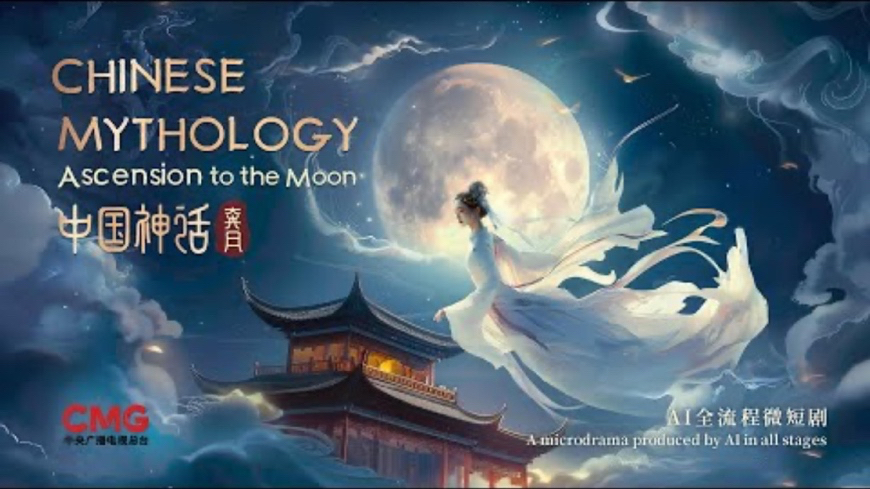
In Beijing, one showcase example at the ABU AI and Media conference was Chinese Mythology, described as China’s first AI-produced miniseries produced throughout the whole process by AI — from art direction and storyboarding to visuals, dubbing, and music.
It was produced by China Media Group’s Yangshipin platform, together with CMG’s AI lab and Tsinghua University’s Metaverse Culture Laboratory.
At the time, I was struck by the AI advances. What I did not yet understand was the global commercial infrastructure being built around microdramas. Since then, the pattern has become easier to see.
In November 2025, Chen Kun, director of the AI fantasy series Strange Mirror of Mountains and Seas, told AFP that even if AI could not yet match traditional filmmaking, it could already meet the needs of microdramas “as a first step”.
China’s viral AI-generated microdrama Feng Shui Tian Shi (Feng Shui Heavenly Master), a supernatural drama following a feng shui master who uses the ancient art to confront malevolent forces, was reported to have passed 100 million views within 12 hours on Douyin. Industry data cited by Xinhua said AI-generated comic-style microdramas accounted for about 16.8 billion yuan in market share in 2025, with more than 10,000 such productions being released monthly since the start of 2026.
For most live-action titles, the AI gains still look more hybrid than fully autonomous — strongest in dubbing, localisation, testing, and workflow compression rather than total replacement. But AI is no longer cutting costs in just one part of the chain. It is compounding across production, distribution and audience testing.
To scale globally, studios are using voice cloning and automated lip-syncing to deliver performances in 30 languages from day one.
Tang Jili, executive producer of Feng Shui Tian Shi, put it plainly: “AI has opened up new possibilities. We can tell good stories through visuals that anyone can understand and deliver them in dozens of languages and markets at once.”
Cheaper content is only part of the story. The bigger shift is faster learning. This starts to look less like a film business and more like an app business — one built to test, iterate, acquire traffic and watch retention in real time. The algorithm begins to look a lot like the editor-in-chief.
Why this is different from previous format shifts
Media has always had low-cost forms. What makes microdramas different is that lower production cost is arriving alongside AI-enabled workflow compression.
That changes what competition starts to mean. You’re no longer simply making shows. You’re running a high-velocity story lab.
The ownership questions around AI-assisted content are also diverging by jurisdiction — a complication worth watching as production scales globally.
The media industry outside China has moved from curiosity to a catch-up sprint.
Korean companies are bringing K-drama storytelling expertise into the vertical format and scaling fast.
Vigloo, backed by Krafton, the South Korean gaming giant behind PUBG, is doubling its slate to 400 original titles in 2026. It is expanding to Los Angeles — with US audiences already generating half its revenue. Its new Bloodbound Luna English-language supernatural microdrama for young adults was produced using a fully AI-native workflow in eight weeks by a team of fewer than 10.
Fox Entertainment has taken a strategic stake in the MyDrama platform, with a pipeline of 200 original vertical titles in development. Romance giant Harlequin announced a deal to adapt 40 of its iconic romance titles into animated microdramas using an AI-powered system.
TikTok has launched a dedicated microdrama app called PineDrama in the US and Brazil designed entirely for serialised binging.
When a gaming investor, a romance publisher, a Korean drama studio, a US entertainment group, and a social media giant are all making the same structural move from completely different starting points, that’s not a trend. That’s a bet.
The fast-food storytelling problem — and why it isn’t the whole story
None of this means the critics are wrong. A lot of microdramas do look like fast-food storytelling: formulaic, built for speed, and optimised for compulsion rather than craft. They move quickly, deliver an immediate hit, and are easy to dismiss on taste alone.
That same tempo carries its own risks. Repetition, cliffhanger overload, and rising acquisition costs can flood the market just as quickly as they build it. The factory can scale attention, but it can also accelerate fatigue if quality and variety do not keep pace.
But the more important question remains: are microdramas inherently limited to fantasy and wish fulfilment, or can the format carry something more useful?
China’s government has begun directing the format toward public goals, including tourism, cultural heritage, legal literacy, rural development, and science education. Its “Micro Drama Plus” initiative set out to produce roughly 300 microdramas in 2025, tying the format more explicitly to public-facing objectives.
The ambition has been not just to automate microdrama production, but to raise the format’s production values and social legitimacy.
Belgian public broadcaster VRT has greenlit Red Flag, its first “vertical thriller” drama series, designed for VRT MAX and TikTok.
Finland’s public broadcaster Yle has commissioned Survival Sisters, a 20-part vertical mockumentary for Yle Areena and its social channels. It’s framed as premium storytelling for younger audiences.
Japan’s Asahi Television is exploring how microdramas can function as gateways into its broadcast and streaming content, and as amplifiers that extend existing IP.
And BBC Children’s has commissioned a YouTube-first microdrama spin-off of a show called The Next Step, which will also be available on BBC iPlayer.
These are not unified experiments — VRT is testing format, Yle is chasing younger audiences, Asahi is treating microdramas as IP amplifiers. But together they mark a shift from curiosity to active positioning.
Media organisations sit on decades of archives, reporting, production assets, and underused storytelling potential. Every broadcaster and publisher is already holding material that was too slow, too expensive, or too awkward to give full expression to in traditional formats: local histories, regional stories, reporting that never found its second life, and cultural memory buried in archives.
What happens when you look at that material through the lens of a format that can be assembled faster, adapted for different audiences, localised more easily, and distributed natively into mobile attention? That’s not a hypothetical. That’s a commissioning brief.
That’s where this stops looking like someone else’s curiosity and starts looking like a live strategic question.
The Real Question
In Beijing last year, I watched a room full of broadcasting executives go quiet as production workflows collapsed into single text prompts. Back in Australia, I found myself unexpectedly hooked by the commercial microdrama machine.
The platforms building this high volume market are spending heavily on social advertising to acquire audiences that established broadcasters and publishers already have, and developing IP from scratch that those organisations already hold.
AI production tools are also unlocking stories that were previously too ambitious or too expensive to tell — historical reconstructions, regional mythologies, cultural archives that never made it to screen.
The industrial conditions of storytelling are changing.
The question isn’t whether the material or the audience exists. It’s whether established media moves while the format is still open — or arrives after the platforms have already built the habit.
The audience is already in the vertical feed.
Authored by:
Craig McCosker
Group Product Manager, Future Focus
ABC Digital Product